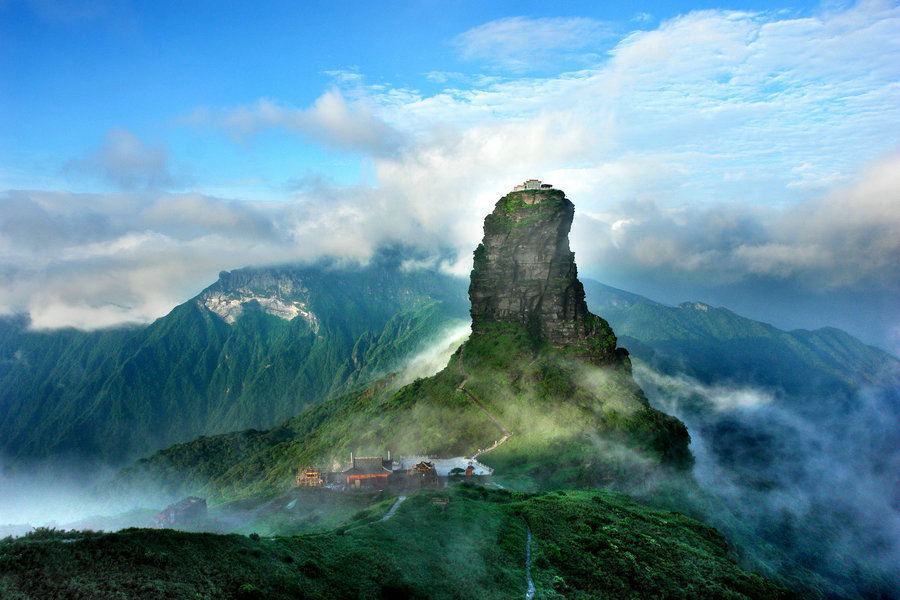
Fanjing Mountain
Introduction
Fanjing Mountain, located in Tongren city, Guizhou province, stands as a notable cultural and natural marvel in China. As the main peak of the Wuling Mountains, Fanjing Mountain reaches an impressive elevation of 2,572 meters. It covers an area of 402.75 square kilometers, with an additional buffer zone of 372.39 square kilometers. This geographical setting contributes to the mountain's unique landscape, characterized by rugged terrains, dense forests, and crystal-clear creeks. The mountain's elevation gradient supports diverse ecosystems, offering visitors a spectacular view that includes evergreen forests, wildflowers, valleys, rocks, cliffs, and peaks. These features have not only shaped the local environment but also influenced the mountain's climate and biodiversity. With a rich history extending over two thousand years, this mountain has earned its reputation as a prominent cultural site. It is recognized as China's fifth-largest sacred Buddhist mountain, reinforcing its cultural and religious significance.
In July 2018, the mountain achieved international recognition when it was inscribed on the World Natural Heritage List, underscoring its outstanding universal value and ecological importance.
Biodiversity
Fanjing Mountain is renowned for its exceptional biodiversity. It is home to an incredible array of wildlife, including 4,394 species of plants and 2,767 kinds of animals. The mountain is a sanctuary for endangered and rare species, such as the Guizhou golden monkey and the Fanjingshan fir. It is also the most significant area for gymnosperm diversity worldwide and an essential protective zone for beech forests in Asia. The mountain's ecosystem harbors 31 endangered plants and 19 threatened animals, making it a critical site for conservation efforts aimed at preserving these species and their habitats.
Cultural Significance
As a famous cultural mountain with more than two thousand years of history, Fanjing Mountain has long been a site of spiritual and cultural importance in China. Over the centuries, it has attracted pilgrims, scholars, and travelers, contributing to its status as a revered cultural landmark. The mountain's historical landscape is further enriched by its association with Buddhism, making it a sacred site with profound historical resonance.
The religious significance of Fanjing Mountain is most prominently reflected in its status as the fifth-largest sacred Buddhist mountain in China. This designation highlights its importance as a spiritual destination for Buddhists. The presence of two Buddhist temples perched atop the mountain's peak enhances its religious appeal, providing a place for meditation and spiritual reflection. These temples not only attract pilgrims seeking spiritual enlightenment but also intrigue visitors with their architectural marvel, given their precarious location on the mountain.
Conservation Efforts
Conservation efforts at Fanjing Mountain are pivotal in preserving its unique ecosystems and biodiversity. In 1978, the Fanjingshan National Nature Reserve was established to protect the area's precious wildlife and plant species, along with its primeval forest ecosystem. The International Union for Conservation of Nature (IUCN) recognized the mountain's aesthetic value and biological diversity, contributing to its nomination as a World Natural Heritage Site. Local authorities and conservationists are focused on balancing ecological protection with sustainable tourism development, ensuring that the natural heritage is preserved while accommodating visitors.
Tourism
Attractions
Fanjing Mountain offers a range of attractions that captivate adventure seekers and nature enthusiasts alike. Its breathtaking landscapes, including dense forests, clear creeks, and imposing peaks, provide an ideal setting for exploration and photography. The ascent to the peak is challenging but rewarding, with visitors treated to panoramic views and the remarkable sight of Buddhist temples seemingly defying gravity on the mountaintop. The mountain's natural beauty varies with the seasons, offering different vistas and experiences throughout the year.
Visitor Guidelines
Visitors to Fanjing Mountain are encouraged to prepare for a physically and mentally demanding experience, especially if they wish to reach the peak. The path to the top is steep and narrow, necessitating careful navigation and caution. Due to the presence of venomous snakes in the area, tourists are advised to stay on designated paths and avoid venturing into bushes. It is recommended to visit outside of national holidays to avoid crowds and to ensure a more serene experience. Adhering to the guidelines ensures visitor safety and helps protect the mountain's fragile environment.
Tourism development plans are underway to enhance visitor experiences while maintaining ecological integrity. Local authorities are committed to improving facilities, promoting health and wellness tourism, and integrating cultural elements to enrich the visit. These efforts are designed to create an all-encompassing destination that encourages longer stays and deeper engagement with the natural and cultural heritage of Fanjing Mountain.








